Understanding Window Styles, Materials, and Energy Efficiency Features for Homes
Windows do far more than let in daylight. They influence indoor comfort, monthly utility costs, curb appeal, outside noise, ventilation, and even how secure a home feels on a stormy night. Because replacement windows can be expensive and long-lasting, understanding the differences between styles, frame materials, and efficiency features helps homeowners avoid costly guesswork. This guide breaks the topic into practical parts so choosing wisely feels manageable.
1. Why Window Knowledge Matters and a Clear Outline for the Journey Ahead
Many homeowners begin a window project with a simple question: what looks good from the street? Appearance matters, of course, but windows are working parts of the house, not decorative stickers. They regulate airflow, hold back rain, soften noise, frame outdoor views, and help keep indoor temperatures stable. A well-chosen window can make a bedroom quieter, a kitchen brighter, or a heating bill less painful in winter. A poorly chosen one can invite drafts, condensation, maintenance headaches, and regret that lingers longer than the paint color ever will.
This article follows a practical outline so the subject stays clear instead of overwhelming. Here is the roadmap:
• First, how window styles differ in operation, ventilation, sightlines, and ideal room placement.
• Second, how frame materials compare in durability, maintenance, insulation, and cost.
• Third, which energy efficiency features truly matter, including glass coatings, gas fills, and label ratings.
• Fourth, how to match those features to climate, budget, and home design without chasing gimmicks.
Think of it as a guided walk through the showroom, but with less sales talk and more useful context.
The relevance of this topic is easy to see in everyday life. Energy prices remain a concern in many regions, and homes lose or gain heat through windows more easily than through insulated wall assemblies. Older single-pane units or worn frames can also create uncomfortable hot spots and cold zones near seating areas. On the design side, window choices influence how natural light moves through a home from morning to evening. A tall casement in a breakfast nook feels different from a wide picture window in a living room, even if both technically “add light.” The decision touches function and atmosphere at the same time.
There is also a financial reason to learn the basics before buying. Window costs vary widely depending on size, glazing package, frame material, brand, and installation complexity. Choosing the wrong configuration can increase upfront costs without delivering meaningful benefits for a specific house. For example, triple-pane glass may be sensible in a very cold climate, while in a milder area the extra cost may not always produce a dramatic payoff. Good decisions rarely come from chasing the most expensive option; they come from matching features to actual needs.
By the end of this article, homeowners should be able to compare options more confidently, read specification labels with less confusion, and ask sharper questions before signing a contract. That is the real goal: not perfection, but better judgment.
2. Understanding Window Styles: Function, Ventilation, and Visual Impact
Window style is the first layer most people notice, because it changes both the outside character of the house and the inside experience of a room. Yet style is not just a design choice. It affects how much air enters, how easy the unit is to clean, whether furniture placement becomes awkward, and how wide the outdoor view feels. In that sense, choosing a window style is a little like choosing a door for each room: the mechanics matter as much as the shape.
Double-hung windows remain common in many homes, especially traditional and transitional designs. Both sashes can often move, which gives flexibility for ventilation and cleaning. They suit bedrooms, living rooms, and front façades where symmetry matters. Their tradeoff is that the meeting rails create a horizontal line across the view, and they may not seal as tightly as some compression-style windows when compared with high-quality casements. Single-hung windows look similar but usually have only one moving sash, making them simpler and sometimes less expensive.
Casement windows hinge at the side and open outward like a book. Because they use a crank and close against the frame with compression seals, they are often praised for strong airtightness when properly made and installed. They also catch side breezes well, which is useful in kitchens or sitting rooms where airflow matters. Awning windows operate similarly but hinge at the top, making them practical above sinks or in basements, where they can remain cracked open during light rain. The downside for both styles is exterior clearance; they project outward and may not suit every walkway, porch, or tight side yard.
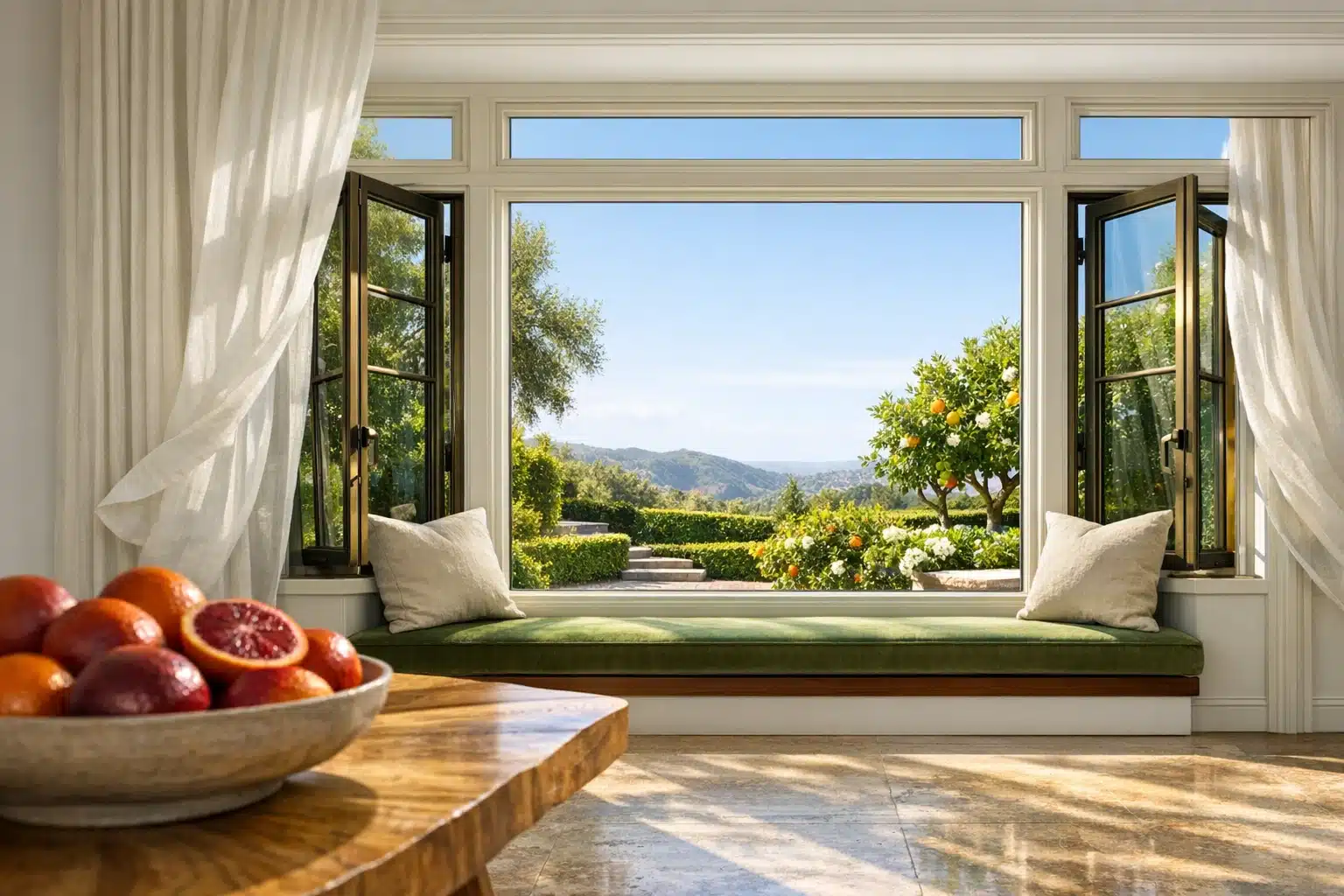
Sliding windows open horizontally and are often chosen for contemporary homes, broad wall spaces, or rooms facing patios. They are easy to use and usually provide a wide view, but only part of the opening is available for ventilation at one time. Picture windows do not open at all, yet they create uninterrupted glass areas that flood interiors with light and showcase landscapes. Used thoughtfully, they can make a room feel almost cinematic, as if the garden has been framed and hung on the wall.
Other specialty styles serve specific goals:
• Bay and bow windows project outward, adding light, depth, and a sense of spaciousness.
• Hopper windows hinge inward from the top or bottom and are often used in basements.
• Garden windows extend outward and can create a small shelf-like greenhouse effect in kitchens.
• Egress windows in bedrooms or basements must meet local code requirements for emergency exit.
The best style depends on room use, ventilation needs, architecture, and even daily habits. A beautiful window that is hard to reach, difficult to clean, or poor at capturing airflow can become an expensive compromise. When homeowners compare styles through the lens of real living rather than catalog photos alone, the decision becomes much more practical.
3. Comparing Window Frame Materials: Durability, Maintenance, Cost, and Character
Once style is chosen, frame material becomes the next major decision, and this is where tradeoffs become especially important. No single material is ideal for every house, climate, or budget. Instead, each option balances looks, maintenance demands, insulation performance, longevity, and price in its own way. Homeowners often focus on the visible finish, but the material beneath that finish shapes how the window behaves over time.
Vinyl is one of the most common options because it is generally affordable, low-maintenance, and resistant to rot. It does not need painting, and many modern vinyl windows offer decent thermal performance thanks to multi-chambered frame construction. For budget-conscious projects, vinyl often provides solid value. Its limitations are mostly aesthetic and structural. Color choices can be more limited, darker shades may absorb more heat, and lower-end vinyl products can feel less rigid than premium alternatives. Quality varies sharply, so “vinyl” alone does not tell the whole story.
Wood remains a favorite for homeowners who love warmth, texture, and traditional character. A wood interior can make a room feel finished in a way synthetic materials sometimes struggle to match. Wood also insulates naturally and can be painted or stained. However, it requires upkeep. If moisture management is poor, wood can swell, peel, or rot. In historic homes, that maintenance may be worth the effort because authenticity matters. In busy households that want minimal upkeep, it may feel like adopting a charming but demanding pet.
Fiberglass has earned attention for combining strength, dimensional stability, and relatively low maintenance. It expands and contracts less than some materials under temperature swings, which can support durability and seal performance. Fiberglass can also mimic painted wood more convincingly than many vinyl products. The tradeoff is cost; it often sits above vinyl and can approach premium pricing. Still, for homeowners planning long-term occupancy, it is frequently considered a strong middle ground between practicality and performance.
Aluminum is valued for slim frames and contemporary appearance. It is strong and can support large glass areas with narrow sightlines. That makes it attractive in modern designs where clean lines matter. The challenge is that aluminum conducts heat readily, so without a thermal break it can underperform in efficiency compared with other materials. It can work well in certain climates and design contexts, but it requires careful product selection.
Composite frames vary by manufacturer but generally blend materials to improve strength, stability, and insulation. Some aim to deliver the look of painted wood with less maintenance. Because this category includes different formulas, homeowners should compare actual performance data rather than assuming all composites behave alike.
A simple comparison checklist can help:
• Lowest maintenance: vinyl, fiberglass, many composites
• Strong traditional appearance: wood
• Sleek modern sightlines: aluminum
• Strong all-around durability: fiberglass, high-quality composite
• Most budget-friendly entry point: vinyl
In the end, the right frame material should fit the home’s architecture, the owner’s maintenance tolerance, and the project budget. Material choice is less about finding a universal winner and more about choosing the right partner for the life the house actually leads.
4. Energy Efficiency Features Explained: Glass, Coatings, Gas Fills, and Performance Ratings
Energy efficiency is the part of window shopping that often sounds technical, but the basics are easier to grasp than they first appear. A window’s efficiency depends on the whole assembly, not just the glass. Frame design, spacers, seals, and installation all matter. Still, the largest conversation usually centers on glazing, because that is where heat gain, heat loss, glare control, and comfort are most directly influenced.
Single-pane windows are now uncommon in new high-performance products because they provide limited insulation. Double-pane windows, which trap a space between two layers of glass, are far more common and are often the standard choice for many homes. Triple-pane windows add another layer and another insulating space, improving thermal performance and often reducing outside noise. In cold climates, that extra layer can improve comfort near the glass surface. In milder regions, homeowners should weigh whether the extra cost matches the expected benefit.
Low-emissivity, or Low-E, coatings are one of the most important efficiency features. These microscopically thin coatings help reflect infrared heat while still allowing visible light to pass through. In plain terms, they help keep indoor heat inside during colder weather and reduce unwanted solar heat gain during warmer periods, depending on the coating type. Some products are optimized for colder climates, while others are designed to block stronger sun exposure in hot regions.
Gas fills such as argon or krypton are often placed between panes because they conduct less heat than ordinary air. Argon is common and cost-effective; krypton is typically used in narrower spaces or premium assemblies. Warm-edge spacers, which separate the panes at the edges, also matter because edge performance affects condensation resistance. A window is often only as comfortable as its coldest perimeter.
Homeowners should also learn the main rating terms, often displayed on labels from organizations such as the NFRC:
• U-factor measures how readily heat passes through the window; lower numbers indicate better insulation.
• Solar Heat Gain Coefficient, or SHGC, measures how much solar radiation the window admits; lower numbers help reduce heat gain in hot climates.
• Visible Transmittance indicates how much natural light passes through the glass.
• Air Leakage measures how much air can move through small gaps; lower is generally better.
• Condensation Resistance gives a sense of how well the product resists interior moisture buildup on glass and frames.
Climate should guide interpretation. In colder regions, homeowners often prioritize a lower U-factor. In hotter, sunnier regions, SHGC may become a bigger concern, especially on west-facing windows that catch intense afternoon sun. Orientation matters too. A house with large south- or west-facing glass areas may need different glazing strategies than one shaded by trees or neighboring buildings.
Efficiency features do not work in isolation. Even an excellent window can disappoint if installed poorly, if flashing details are weak, or if gaps around the frame are not sealed correctly. That is why the smartest view of efficiency combines product specs with workmanship. Labels tell part of the story; the final chapter is written on the job site.
5. Choosing the Right Windows for Your Home: Practical Decisions, Common Mistakes, and a Homeowner-Focused Conclusion
By the time homeowners compare styles, materials, and performance labels, the project can start to feel like a puzzle with too many pieces. The good news is that a practical decision framework usually simplifies things quickly. Start with the house itself. Consider climate, orientation, architectural style, outside noise, maintenance expectations, and which rooms feel uncomfortable now. A drafty upstairs bedroom, a sun-baked west-facing den, and a street-facing living room may each benefit from different priorities, even within the same home.
Budget should be approached carefully, not emotionally. The least expensive quote is not always the best value, and the most feature-loaded proposal is not automatically the smartest one either. Compare like with like: frame material, glass package, hardware quality, warranty terms, installation scope, and whether exterior trim or interior finishing is included. A lower quote can rise quickly if key details are excluded. Ask whether the installer will address flashing, insulation around the frame, and any hidden damage found after removal of old units. Those details affect long-term performance as much as the product brochure does.
Several common mistakes are worth avoiding:
• Choosing style based only on appearance without considering airflow, cleaning access, or furniture placement.
• Paying for premium glazing that does not match the local climate or the home’s exposure.
• Ignoring frame maintenance requirements, especially with wood in wet or high-sun conditions.
• Overlooking installer skill, which can undermine even a high-quality product.
• Replacing windows to solve every comfort problem when air sealing, shading, or insulation upgrades may also be needed.
It is also smart to think in time horizons. If the homeowner plans to move soon, priorities may lean toward durable value, broad appeal, and visible condition. If the house is a long-term home, it may make more sense to invest in better comfort, quieter interiors, and lower maintenance over decades. Historical homes may prioritize appearance and proportions. Modern homes may value large expanses of glass and slimmer frames. Family homes may care most about easy operation, safety features, and simple cleaning.
For the target audience of this guide, the clearest conclusion is this: the best window is not the one with the flashiest label or the most dramatic marketing language. It is the one that fits the home, the climate, and the people living behind the glass. When homeowners understand how style influences function, how material shapes upkeep and durability, and how efficiency ratings translate into real comfort, they buy with far more confidence. A thoughtful window choice can brighten rooms, steady indoor temperatures, and make everyday life feel just a little more settled. That is a worthwhile return, even before the first sunrise hits the new glass.