All-New 2026 Ford Mustang: Exciting New Features
In today’s market, the Mustang is more than a familiar badge with a running horse on the grille; it is one of the few mainstream performance cars still blending rear-wheel-drive balance, open-road drama, and everyday usefulness. The 2026 model matters because it carries that idea forward at a time when several traditional rivals have changed direction or disappeared. Instead of asking whether it looks exciting, a better question is whether its newest features make the car more rewarding to live with, drive hard, and choose over newer alternatives.
Outline: This article begins with the 2026 Mustang’s position in the current market and the likely shape of the lineup. It then moves into engines, transmissions, and performance hardware before exploring the interior, digital systems, and comfort story. After that, it examines design, handling, safety, and real-world practicality. It closes with a buyer-focused conclusion aimed at drivers deciding between the EcoBoost, GT, and Dark Horse versions.
Where the 2026 Ford Mustang Fits in Today’s Performance-Car Landscape
The first important thing to understand about the 2026 Ford Mustang is that “all-new” may describe the ownership experience more than a complete engineering reset. Ford already introduced the latest Mustang generation on the S650 platform, so the 2026 car is best viewed as a continuation of that formula with ongoing refinements, package updates, and feature adjustments rather than a clean-sheet reinvention. That distinction matters because it sets realistic expectations. Buyers should not expect a radical change in body shape or a surprise powertrain revolution across the board. What they can reasonably expect is a more mature version of a car that already had to balance heritage, emissions pressure, technology demands, and a market increasingly crowded by crossovers and electrified performance models.
That context makes the Mustang unusually relevant. The Chevrolet Camaro’s exit from regular production narrowed the traditional pony-car field, while Dodge has been reshaping the Charger identity with new platforms and propulsion strategies. As a result, the Mustang now occupies a larger symbolic space than its sales numbers alone suggest. It is not just another sporty coupe; it is one of the last accessible, mass-market cars still offering a naturally aspirated V8, rear-wheel drive, and a manual gearbox in a recognizable American package. For enthusiasts, that alone gives the 2026 model a kind of cultural gravity. For mainstream shoppers, it means the car has to do more than sound good at a stoplight. It must also offer decent connectivity, comfort, driver assistance, and value.
At a glance, the likely core lineup remains familiar:
– EcoBoost fastback for buyers who want speed with lower running costs
– GT fastback and convertible for the classic V8 experience
– Dark Horse for shoppers who want stronger track capability and sharper hardware
– Appearance, wheel, and comfort packages that may vary by market and model year
What makes this setup effective is breadth. The EcoBoost speaks to younger buyers, commuters, and anyone who wants the Mustang shape without the fuel appetite of a V8. The GT remains the emotional center of the range because the 5.0-liter “Coyote” engine still delivers the soundtrack many people associate with the nameplate. The Dark Horse serves a different role: it is the Mustang for drivers who read brake rotor sizes, lap times, and cooling upgrades before they even ask about paint colors. In other words, the 2026 Mustang continues to matter because it still knows how to play several roles at once. It can be an attainable coupe, a charismatic grand tourer, or a near-track-ready toy, and that flexibility is one of its strongest features.
Powertrains and Performance: Why the Mustang Still Feels Special
If the Mustang has always had a heartbeat, it lives under the hood. For 2026, the most exciting features are likely to remain tied to the engine lineup and the way Ford has preserved multiple personalities within one model family. On the current generation, published figures place the turbocharged 2.3-liter EcoBoost around 315 horsepower and 350 lb-ft of torque, while the 5.0-liter V8 in the GT reaches roughly 480 horsepower in standard form and 486 horsepower with active-valve exhaust. The Dark Horse sits at the top of the naturally aspirated lineup with an even 500 horsepower. Unless Ford announces major revisions, these numbers form the clearest baseline for what buyers can expect from the 2026 car.
The EcoBoost deserves more respect than it sometimes gets in enthusiast circles. It is lighter over the nose than the V8 models, which can help the car feel eager and tidy on turn-in. For drivers who spend more time on mixed roads than on drag strips, the four-cylinder version often makes practical sense. Turbo torque arrives early, fuel costs are easier to manage, and the overall experience is still quick enough to feel lively in daily use. A modern Mustang no longer needs eight cylinders to embarrass traffic merging onto the highway. That is a useful reality, even if it does not create the same theater as a GT leaving a tunnel with the exhaust open.
The GT remains the core experience for many buyers because a naturally aspirated V8 offers something numbers alone cannot fully explain. The throttle response feels immediate, the powerband builds in a more linear way, and the soundtrack turns a routine drive into a small event. If you imagine a Saturday morning on an empty back road, sunlight flashing across the hood, and a downshift that sounds like old-school mechanical confidence, you are already thinking like a GT customer. Ford’s continued support for a six-speed manual is especially important here. In an era when many performance cars have moved entirely to automatics, the manual Mustang still gives drivers a physical, deliberate connection to the car. For those who prefer convenience or slightly quicker acceleration, the 10-speed automatic remains a very capable option.
Performance features strengthen the appeal further. Depending on trim and package, buyers can expect options or availability such as:
– selectable drive modes for different road conditions
– launch-oriented performance settings
– rev matching on manual configurations
– active exhaust tuning
– larger brakes and chassis upgrades on more serious trims
Compared with rivals like the Nissan Z or Toyota GR Supra, the Mustang’s powertrain story is broader. The Supra is focused and fast, but it offers fewer body styles and no V8. The Z has charm, yet its cabin and refinement have drawn mixed reactions. The Mustang’s advantage is that it can be tailored to very different tastes without losing its central identity. That is why its performance still feels special in 2026: the car offers speed, sound, and choice, not just one of the three.
Inside the Cabin: Digital Screens, Comfort, and the Everyday Experience
One of the biggest shifts in the latest Mustang generation was not mechanical at all; it was visual. The dashboard moved decisively into the digital age, and that modern layout is one of the most relevant features for the 2026 model. Recent Mustangs on this platform use a 12.4-inch digital instrument cluster paired with a 13.2-inch center touchscreen angled toward the driver. That arrangement changed the cabin from a traditional muscle-car cockpit into something that feels closer to a performance-minded tech product. Some purists missed the older analog flavor, but for many drivers the new layout makes the car easier to live with because the displays are clear, configurable, and better suited to modern infotainment expectations.
Ford’s software integration is central to the appeal. The latest system has supported wireless Apple CarPlay and Android Auto, voice functionality, connected services, and over-the-air update capability on applicable features. The digital cluster can also present different visual themes, including designs inspired by earlier Mustang eras. That detail may sound playful, yet it reflects a smart idea: the car uses technology not to erase its history, but to reinterpret it. A Mustang has always traded partly on emotion, and letting drivers shift the mood of the instrument panel is a small but telling way of blending nostalgia with convenience.
Comfort and usability have improved too. The previous generation could feel dated next to newer rivals, especially in the quality and placement of screens. The current interior is cleaner, more open, and less dependent on old-fashioned button clutter. Trim materials still vary by model and options, and no one should confuse a mainstream Mustang with a hand-built luxury coupe, but the cabin now feels more competitive in the areas that matter most every day. Supportive seats, a more contemporary interface, and a better sense of design coherence make a real difference during commutes, errands, and longer trips.
There are also practical considerations buyers should weigh:
– front-seat comfort is generally strong, especially with sport-oriented seating packages
– rear seating remains more occasional than spacious, as is typical for the segment
– the coupe body style is usually more useful for cargo flexibility than many smaller sports cars
– convertible buyers gain open-air appeal but sacrifice some trunk practicality and structural rigidity
Compared with a BMW 2 Series or an entry-level luxury coupe, the Mustang may not deliver the same premium badge atmosphere, but it offers a more distinctive sense of occasion. Compared with an older Mustang, the jump in digital sophistication is dramatic. That matters because many performance cars now have to win the weekday as well as the weekend. The 2026 Mustang’s cabin succeeds when it makes the car feel current without sanding away its personality. You still know you are in something playful, but the technology no longer feels like an afterthought. For buyers who want a car that can entertain on a back road and still handle navigation, streaming, and smartphone life without friction, this is one of the most meaningful areas of progress.
Design, Handling, Safety, and the Features That Shape the Drive
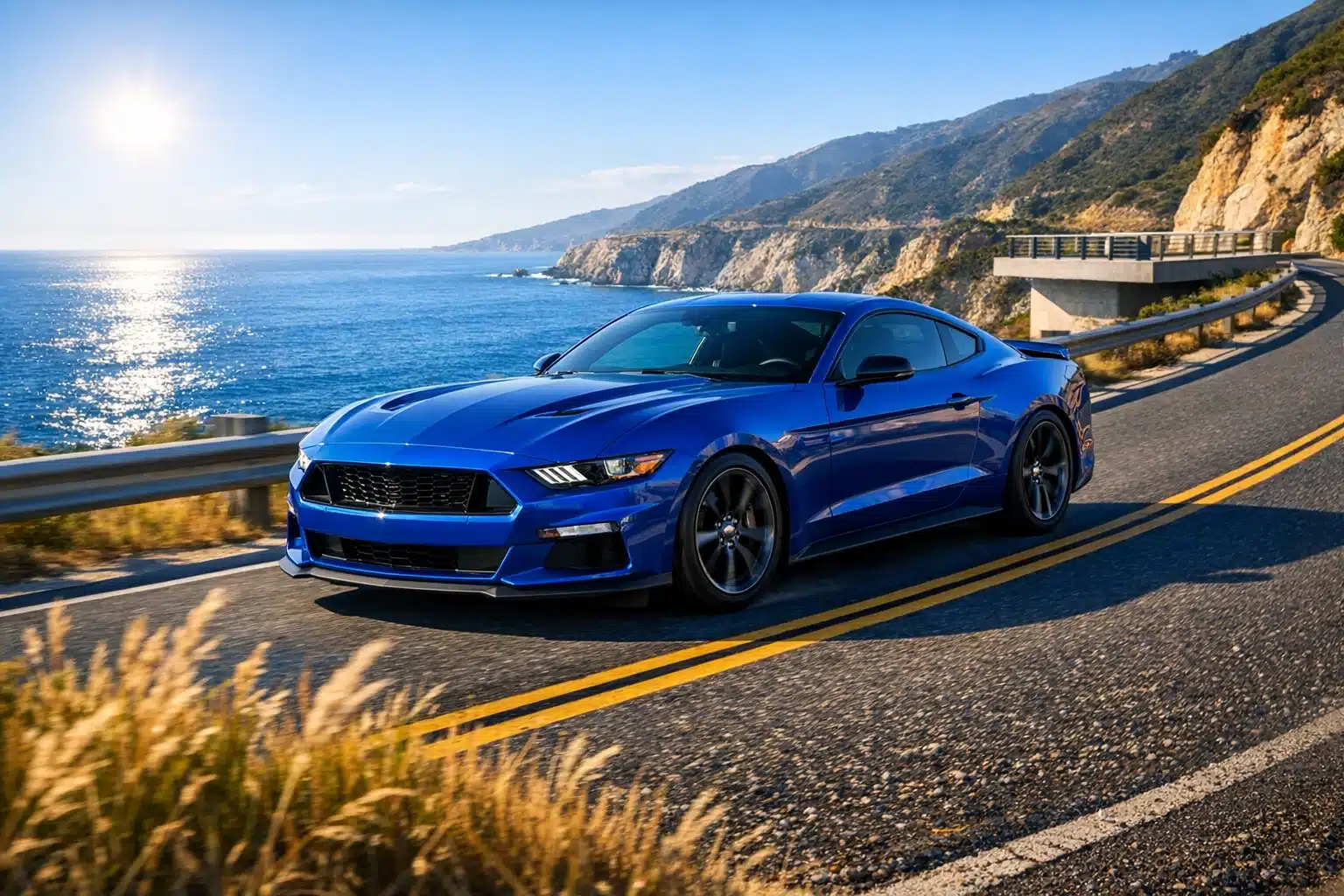
Visually, the latest Mustang formula has avoided reckless redesign for a reason: Ford knows the shape is part of the product. The 2026 car is expected to continue the sharper, more technical look of the current generation, with a low nose, tri-bar lighting signatures, muscular rear haunches, and a stance that still reads as unmistakably Mustang from a distance. It does not chase retro styling as heavily as some earlier versions did, yet it has not abandoned recognizable cues either. That balance is important. A Mustang should not look anonymous in a parking lot, and it should not feel trapped in costume jewelry nostalgia. The current design walks that line well by appearing cleaner, more deliberate, and slightly more grown-up than some past versions.
The real story, though, unfolds once the road begins to bend. Modern Mustangs are no longer defined by straight-line performance alone. The independent rear suspension introduced in earlier generations already changed the car’s behavior, and the latest versions continue to build on that progress. With the right configuration, the Mustang can feel planted, surprisingly disciplined, and much less crude than old stereotypes suggest. Optional or higher-trim hardware such as larger brakes, stickier tires, performance packages, and available MagneRide dampers can transform the car from a stylish cruiser into something genuinely serious on a track day. The Dark Horse, in particular, exists to prove that Ford wants the Mustang to be respected in corners, not just remembered for burnouts.
There is still a split in character across the range, and that is not a weakness. An EcoBoost on standard suspension may be the friendlier daily choice, especially for drivers facing broken pavement, mixed weather, or long commutes. A GT with performance hardware becomes more theatrical and more demanding, but also more rewarding when the road opens up. A Dark Horse asks for commitment and gives back sharper responses, stronger cooling, and greater endurance when pushed. Buyers should think carefully about where the car will spend most of its time. The most exciting specification on paper is not always the best one for the life you actually live.
Safety and driver-assistance technology matter more than many enthusiasts admit, and Ford has modernized the Mustang in this area as well. Availability varies by trim and package, but recent models have offered features such as:
– pre-collision assist with automatic emergency braking
– blind-spot monitoring
– lane-keeping support
– adaptive cruise control on selected configurations
– rear parking and camera aids that make the car easier to place in traffic
Compared with a GR Supra, the Mustang generally offers more flexibility thanks to its rear seats and broader trim range. Compared with a Nissan Z, it feels more fully integrated as a daily driver, especially in tech and assistance features. That blend of design confidence, improved chassis sophistication, and livable safety equipment is where the 2026 Mustang makes a compelling case. It still knows how to be dramatic, but it no longer asks you to excuse basic shortcomings in order to enjoy the show.
Final Thoughts for Prospective Mustang Buyers
The 2026 Ford Mustang is most compelling when viewed not as a fantasy object, but as a rare car that still tries to satisfy several kinds of drivers at once. If you are shopping for a performance coupe in an era of electrification, rising prices, and shrinking enthusiast options, the Mustang deserves attention because it preserves meaningful choice. You can still buy into the shape, the sound, and the rear-wheel-drive character without being forced into a single personality. That flexibility is a feature in its own right, and for many buyers it may be the most exciting one of all.
For the audience most likely to consider this car, the decision often comes down to honest self-assessment. The EcoBoost makes sense for drivers who want the style and agility of a Mustang while keeping operating costs, insurance concerns, and day-to-day practicality closer to reason. It is the trim that quietly does more jobs than people expect. The GT is for buyers who know the engine note matters, who want the emotional center of the Mustang story, and who will remember the feel of a V8 long after they forget a touchscreen menu layout. The Dark Horse is best for enthusiasts who genuinely plan to use the extra capability, not just admire it from a spec sheet. It is the one for people who say “cooling package” with a straight face and mean it.
A sensible shopping checklist looks like this:
– choose the engine first, because it determines the car’s character more than any wheel design
– decide whether the manual transmission is part of the dream or a burden in daily traffic
– be realistic about suspension firmness and tire costs if you are considering aggressive performance packages
– compare insurance, fuel, and maintenance expectations before stretching for the highest trim
– test the infotainment, seating position, and visibility, because those details shape ownership every single day
The most impressive thing about the 2026 Mustang is that it does not rely on nostalgia alone, even though it could have. Its latest strengths are broader than raw horsepower: a modernized cabin, strong powertrain variety, sharper handling options, and a clearer sense of purpose in a changing market. For younger buyers, it remains an attainable icon with real personality. For long-time fans, it still speaks the old language of V8 thunder and driver involvement. For anyone in between, it may be one of the last cars that can make a commute feel routine and a Sunday morning feel cinematic. That is why the Mustang still matters, and why the 2026 version remains worth serious consideration.