Family Beach Getaway: 5 Nights Near Elafonissi Beach
Planning a five-night family escape near Elafonissi Beach is less about chasing a perfect postcard and more about creating easy, happy days that actually work with children in tow. This corner of southwest Crete rewards slower travel, with shallow water, scenic drives, village tavernas, and enough nearby variety to keep parents interested without overloading the schedule. A smart base, realistic timing, and a little local know-how can turn a beautiful beach trip into a genuinely restful break.
Outline
- How to choose the right family base near Elafonissi Beach
- How to structure a five-night stay without making every day feel rushed
- What families should know before spending time on Elafonissi Beach itself
- How to manage food, budgeting, packing, and daily logistics
- Which nearby outings add variety while keeping the holiday child-friendly
Choosing the Right Family Base Near Elafonissi Beach
The first real decision is not what swimsuit to pack or which taverna serves the best grilled fish. It is where to sleep. Families planning five nights near Elafonissi Beach usually face a practical trade-off: stay very close to the beach and accept fewer services, or stay farther away and gain better access to supermarkets, restaurants, and evening strolls. There is no single correct answer, because the right base depends on the age of the children, whether you are renting a car, and what kind of holiday your family actually enjoys.
If your main goal is to maximize beach time and minimize road time, areas such as Chrisoskalitissa or nearby small accommodations in the southwest are the most obvious choices. These places can put you within a short drive of Elafonissi, which is especially helpful if you want to arrive early before crowds and stronger midday sun. The downside is that the immediate area is quieter, with fewer shopping options and less variety for dinner. For some families, that calm feels like a gift. For others, it starts to feel limiting by the third night.
Inland villages such as Elos or Kefali can be an appealing middle ground. They offer a more traditional village atmosphere, cooler evenings, and an experience that feels rooted in local life rather than purely coastal tourism. A family staying there may trade a slightly longer drive for more character, more shade, and a slower rhythm. You might hear church bells in the distance, smell wood smoke or roasting meat from a taverna, and feel that the holiday has texture beyond the beach. That matters on a five-night trip, because variety keeps both adults and children more engaged.
Kissamos and, in some cases, Paleochora are better choices for families who want a fuller service base. These towns generally offer more restaurants, larger supermarkets, pharmacies, and easier access to other beaches or excursion points. The trade-off is driving time. Reaching Elafonissi from a larger base can take considerably longer, depending on traffic, road conditions, and where exactly you stay. That might be perfectly manageable with older children, but it can be tiring with toddlers who are happiest when lunch and naps happen on a reliable schedule.
- Choose the closest base if beach access is your top priority.
- Choose a village base if you want calm evenings and local atmosphere.
- Choose a larger town if you value services, shopping, and dining variety.
- Choose an apartment if your family needs flexible breakfasts, snack storage, and laundry.
For most families, a self-catering apartment or family studio is often more practical than a standard hotel room. Having a fridge for fruit, yogurt, water, and beach snacks can save money and make mornings far easier. A small terrace is not a luxury when children fall asleep early and adults still want a quiet evening. In short, the smartest base is the one that reduces friction. Beautiful scenery is easy to find in this part of Crete. Smooth daily logistics are what turn beauty into comfort.
Building a Five-Night Plan That Feels Like a Holiday, Not a Checklist
Five nights sounds generous on paper, yet it disappears quickly if the trip is packed too tightly. Families often make the same mistake in beach destinations: they build a schedule as if everyone has the stamina of a solo backpacker and the patience of a museum curator. In reality, children need pauses, familiar food, shade, and the freedom to do less. A strong five-night plan near Elafonissi is not about seeing everything in western Crete. It is about creating a rhythm that leaves room for swims, naps, snacks, and small surprises.
A practical structure begins with one major outing per day at most. On arrival day, keep expectations low. Settle into your accommodation, buy supplies, and let the children get their bearings. If there is time, a short evening walk or a simple dinner nearby is enough. The second day is often the best moment for your first full Elafonissi visit, because everyone is rested and still excited. Aim to arrive early. Morning light is softer, the parking situation is usually easier, and young children tend to enjoy the beach more before the heat peaks.
Rather than repeating a full beach marathon every day, alternate intense days with lighter ones. One day might include Elafonissi plus a relaxed lunch at a taverna. The next could focus on a village visit, a shorter swim elsewhere, or simply a slow morning on a shaded terrace. That pacing matters. Parents often underestimate how much energy is spent on loading the car, carrying towels, applying sunscreen, finding toilets, and negotiating hunger. A schedule with recovery time is not laziness; it is good design.
Here is a workable five-night rhythm that many families would find realistic:
- Night 1: Arrival, groceries, simple dinner, early sleep.
- Night 2: Full morning at Elafonissi, long lunch, quiet afternoon.
- Night 3: Local village day or a second beach with fewer crowds.
- Night 4: Another early visit to Elafonissi or a half-day return for swimming and photos.
- Night 5: Flexible day for whatever the family enjoyed most, then an unhurried final dinner.
This approach works because it respects both the destination and the people traveling through it. Elafonissi is beautiful, but beauty becomes tiring when forced into a rigid plan. Leave room for wind changes, sleepy moods, and spontaneous detours. One afternoon your child may become fascinated by pebbles, lizards, or the bakery cat outside a village shop, and that memory may outlast any formal excursion. The best family itineraries do not squeeze every minute dry. They keep enough space for the holiday to feel alive.
What Families Should Know Before Spending the Day at Elafonissi Beach
Elafonissi Beach is one of the most photographed coastal spots in Crete, and the images are not misleading, but they are incomplete. The famous scenes usually show shallow turquoise water, pale sand, and the pink-tinged tones that appear in some patches due to crushed shells and marine fragments. What the photos do not show is that the experience can vary significantly depending on wind, season, time of day, and crowd levels. Families who understand that variation are much more likely to enjoy the beach rather than feel surprised by it.
One reason Elafonissi suits families is the shallow lagoon-like area that often allows children to splash in calmer water close to shore. This can be more comfortable than beaches with a steeper drop-off or immediate wave action. Still, conditions are never identical every day, and parents should not assume that a famous family beach is automatically effortless. On windy days, sand can blow, the sea may feel cooler or choppier, and younger children may tire faster. The best strategy is to treat the beach as a natural place, not a theme park with guaranteed settings.
Timing makes a real difference. Arriving early usually improves almost everything: parking, shade options, walking distance to the water, and general calm. By late morning in high season, the beach can become much busier. Families carrying umbrellas, towels, inflatable toys, snacks, and sleeping toddlers already know that every extra meter matters. If you prefer softer light and lower stress, early hours are often worth the effort. The sun in Crete can be intense, especially from late morning through the afternoon, so shade, hats, and frequent water breaks are basic needs rather than optional extras.
There are also practical and environmental considerations. Elafonissi is part of a protected area, and visitors should respect dunes, marked zones, and local guidance. Taking natural materials, trampling fragile vegetation, or treating the site casually chips away at exactly what makes it special. Families can turn this into a positive lesson for children by explaining that beautiful places stay beautiful when people use them gently.
- Go early for easier parking and milder heat.
- Bring sun protection that you can reapply often.
- Pack more water than you think you need.
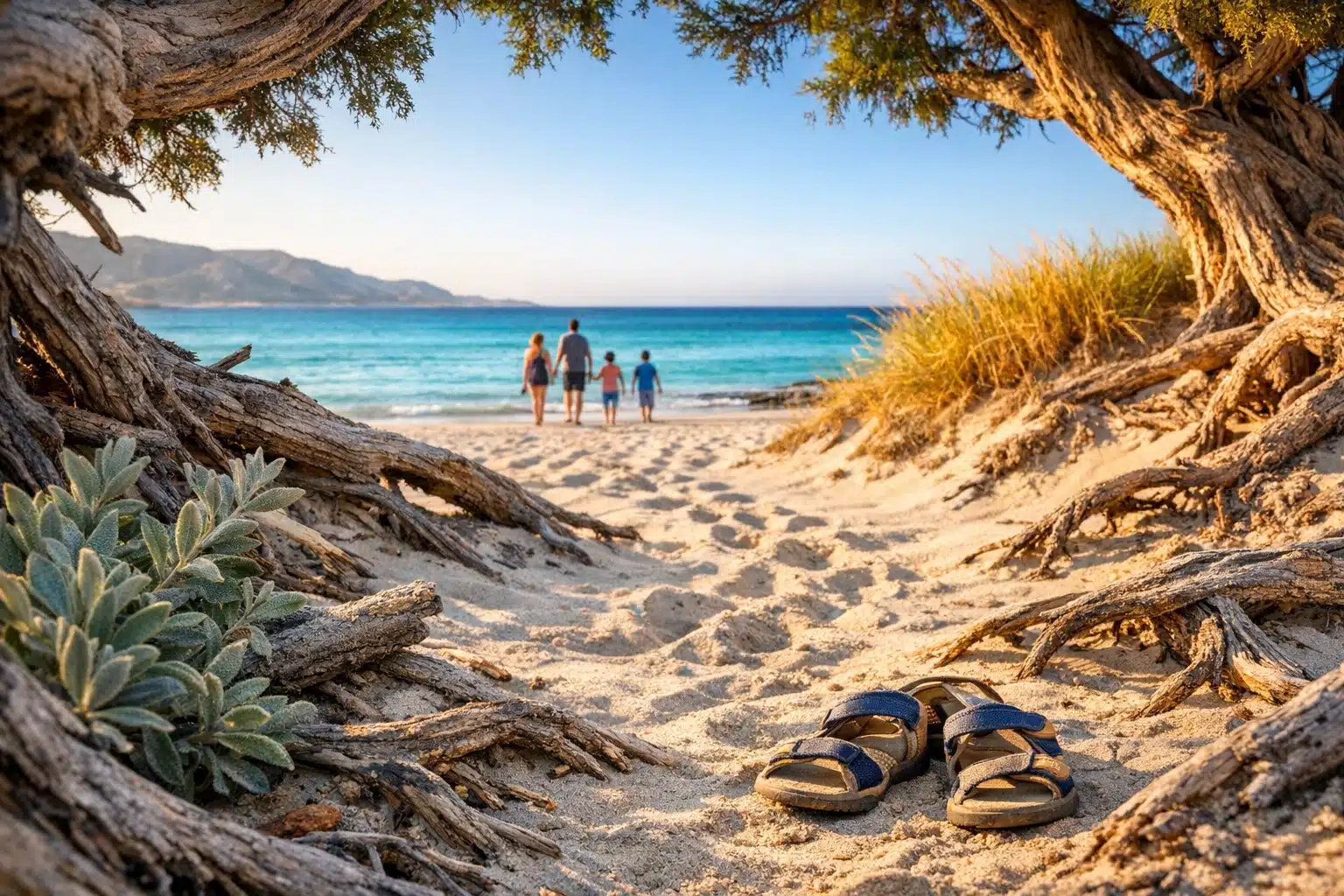
- Use water shoes if your children are sensitive to hot sand or rocky patches.
- Respect protected areas and avoid removing natural materials.
Facilities may be available seasonally, but families should still plan with self-sufficiency in mind. Bring snacks, wipes, and a backup set of clothes. If your children need naps, consider whether your base is close enough for a midday break or whether you will stay only for the morning. Elafonissi can feel magical when the water turns glassy and the horizon seems to melt into the sky, yet the magic is strongest when parents are not scrambling for basics. Prepared families enjoy more and react less.
Food, Budget, and Everyday Logistics for a Smooth Family Trip
A family beach holiday becomes much easier when the boring details are handled well. Meals, water, laundry, fuel, and snack timing may not sound glamorous, but they are exactly the elements that decide whether a day flows or falls apart. Near Elafonissi, where some areas are more remote than larger resort zones, practical planning matters even more. The good news is that families do not need a luxury budget to travel comfortably here. What they do need is a sensible approach to spending.
Accommodation prices vary by season, exact location, and room type, but families should generally expect higher rates for places that combine summer demand, good reviews, and easy beach access. A family apartment often delivers better value than booking two separate rooms, especially if breakfast can be prepared at home. Even a simple setup with bread, fruit, local yogurt, cheese, and tomatoes can reduce the cost of eating out while saving precious morning time. Parents of small children know the truth: the day goes better when no one starts it hungry in a queue.
For lunch and dinner, local tavernas are often one of the joys of Crete. Portions are frequently generous, and many family-friendly places serve straightforward dishes that children recognize easily, from grilled chicken and fries to pasta, bread, salads, and potatoes. Adults can enjoy regional food such as dakos, grilled fish, lamb, pies, or seasonal vegetables without needing a separate dining strategy. A rough meal budget for a family of four can vary widely, but casual tavernas may remain more reasonable than visitors expect if they share dishes and avoid ordering too much all at once. In many places, hospitality still includes a small dessert or fruit at the end, which children tend to remember with impressive enthusiasm.
- Keep bottled water, fruit, crackers, and napkins in the car every day.
- Shop once properly after arrival instead of making small, repeated trips.
- Choose accommodation with a fridge and, if possible, a washing machine.
- Carry some cash, as smaller businesses can be less flexible than city venues.
- Budget extra for fuel if your base involves daily driving on mountain or coastal roads.
Transport is another key cost. In practice, a rental car is close to essential for most families staying near Elafonissi unless they have booked a property with organized transfers and plan to stay almost entirely in one place. Public transport options can be limited or inconvenient for beach gear, tired children, and flexible timing. When you calculate the value of a family getaway, include comfort as part of the budget. Spending a little more on a better-located apartment, a larger car boot, or a nearby supermarket can reduce stress in ways that feel disproportionally worthwhile.
The smartest family budget is not the cheapest one. It is the one that pays for ease where ease matters most.
Nearby Experiences That Add Variety Without Overcomplicating the Trip
Even if Elafonissi is the main reason for coming, five nights in the area feels fuller when the holiday includes a few supporting notes around the main melody. Families often enjoy beach trips more when every day is not visually identical. A village lunch, a short scenic drive, or a quieter coastal stop can refresh the experience without turning the trip into an exhausting road adventure. The trick is to choose nearby outings that complement beach time instead of competing with it.
Chrisoskalitissa Monastery is one of the most straightforward additions, especially because it sits near the route many visitors already use. Adults may appreciate the hilltop setting and views, while children often respond to the simple pleasure of climbing steps and looking out across the coast. It is not an all-day attraction, and that is exactly why it works. Short cultural stops fit family travel better than long, mandatory ones. Inland villages such as Elos can also provide a welcome contrast to sand and sun. A shaded lunch under trees, local bread on the table, and slower conversation can reset the mood of the entire trip.
For families with older children or confident beachgoers, Kedrodasos is sometimes mentioned as an alternative coastal stop. It is admired for its natural beauty and quieter atmosphere, but it is less organized and therefore not equally suitable for every family. Those traveling with toddlers may prefer easier-access beaches with more predictable facilities. That comparison is useful because it highlights a larger truth: the best excursion is not always the most beautiful one on social media. It is the one that fits your group on that specific day.
If you are based farther north or east, a scenic drive through the surrounding landscape can become part of the holiday rather than a chore. Western Crete has a dramatic texture: rocky slopes, olive groves, chestnut areas inland, and roads that reveal the sea like a curtain opening in stages. Children may not remember every place name, but they often remember the shape of the drive, the goat by the roadside, the bakery stop, or the way the sunset made the car windows glow orange.
- Pick one short non-beach outing for every one or two beach-focused days.
- Favor places with easy parking, shade, and simple access.
- Do not force a long excursion just because it looks famous online.
- Use meals as part of the experience, not merely a stop between activities.
Families can also create their own small rituals to give the trip shape. One evening might be dedicated to sunset snacks. Another could be a final-night dinner where everyone names a favorite moment from the week. A child may choose the best swimming day, while a parent remembers the quiet sound of wind through the tamarisk trees. Those little customs turn a standard holiday into a family story. And in the end, that is the real goal: not just visiting Elafonissi, but leaving with a handful of scenes that still feel sunlit when winter arrives.
Conclusion for Families Planning the Trip
A five-night getaway near Elafonissi Beach works best for families who choose comfort over overpacking the itinerary and rhythm over rush. The beach itself can be a wonderful anchor thanks to its shallow water, striking scenery, and broad appeal, but the success of the holiday depends just as much on where you stay, when you go, how you organize meals, and how much driving you ask children to tolerate. Families who build in early starts, rest periods, simple food plans, and one or two low-pressure outings are far more likely to come home refreshed. In a destination as visually famous as Elafonissi, the wisest plan is often the least dramatic one: stay practical, stay flexible, and let the sea do some of the work.